
Table of Contents
The New EU Rule: What Has Changed for Online Sellers?
If customers can buy products through your website, there is an important EU consumer-law change you need to know about.
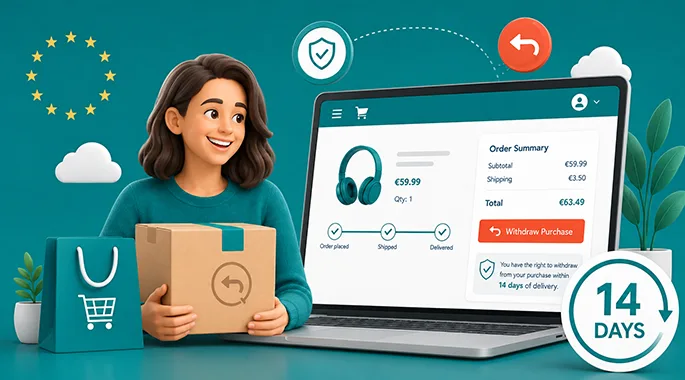
Since 19 June 2026, affected e-commerce websites in Cyprus must provide customers with a clear online way to exercise their legal right to withdraw from an eligible purchase.
In simple words:
If your customer has the legal right to change their mind about an online purchase, your website must now make it easy for them to exercise that right online.
These consumer withdrawal rules generally concern sales from businesses to individual consumers (B2C). Cyprus law defines a consumer as a person acting outside their trade, business or professional activity. Purely business-to-business transactions are therefore a different situation. You can see the definition directly in the Cyprus Consumer Protection Law.
This does not mean every product can always be returned. There are important exceptions for certain products and situations. But having some exempt products does not automatically exempt your entire online shop.
This article explains the 14-day rule, which products may be exceptions, what happens when packaging is opened, who pays the return shipping, what happens after day 14 and, most importantly, what may need to change on your website.
The change comes from EU Directive 2023/2673 and was implemented in Cyprus through the Consumer Protection (Amendment) Law 30(I)/2026. The Cyprus Consumer Protection Service confirms that the new provisions have applied since 19 June 2026.
What Actually Changed on 19 June 2026?
The customer’s right to change their mind about many online purchases is not new.
The big change is how customers must now be able to exercise that right online.
The new law requires affected online businesses to provide a clearly visible and easily accessible withdrawal function. It must remain available during the withdrawal period, allow the customer to submit the request electronically, include a confirmation step and send the customer an acknowledgement after submission.
You can read the requirement directly in Section 22A of the Cyprus Consumer Protection Law.
You may also see the legal term “distance contract.”
Don’t let the word contract confuse you.
If somebody buys electronics, cleaning products, food, shoes, clothing or another product from your website, that normal online purchase creates an agreement between the business and the consumer.
No paper contract. No fountain pen. No lawyer standing beside the checkout.
Just an online purchase.
Cyprus law defines a consumer contract broadly as a contract between a trader and a consumer.
How Does the 14-Day Rule Really Work?
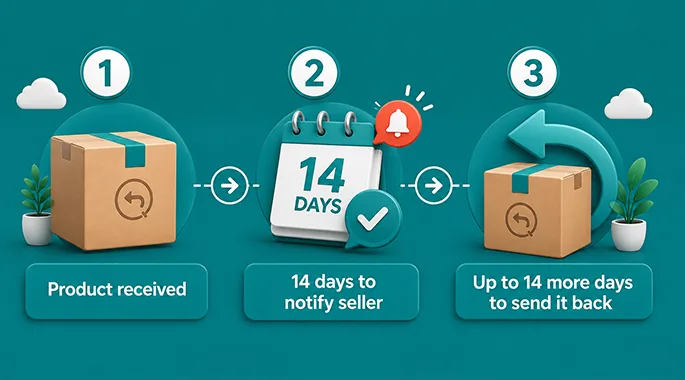
Under the general EU rule, a consumer who buys goods online normally has 14 days from receiving them to tell the seller that they want to withdraw, without having to give a reason. The EU explains the 14-day cooling-off period here.
But there are actually two different deadlines worth understanding.
First 14 days: tell the seller
For most goods, the customer normally has 14 days from receiving the product to tell you that they want to withdraw.
Then: up to 14 days to send it back
Once the customer tells you they are withdrawing, they must return the goods without unnecessary delay and normally no later than 14 days from the day they informed you.
The product does not necessarily have to arrive back within those 14 days. The deadline is met if the customer sends it before that second 14-day period expires.
So this is not automatically:
14 days + another 14 days = everyone always gets 28 days.
If the customer informs you on day 6, for example, the second period begins from that point.
There is protection for the seller too. Although the seller normally has to refund the customer within 14 days of being told about the withdrawal, for goods the seller can generally withhold the refund until the goods are returned or the customer provides evidence that they sent them, whichever happens first.
What if I already offer 30-day returns?
That is fine.
A business can choose to give customers a more generous returns policy than their minimum legal rights.
But your voluntary 30-day return policy and the customer’s legal right of withdrawal are not the same thing.
The important point is that your own Returns Policy cannot remove or reduce the consumer’s statutory rights. The EU’s 14-day withdrawal protection remains the legal minimum where it applies.
When Does the 14-Day Right NOT Apply?
This is probably the most misunderstood part.
The question is not:
“What type of shop do I have?”
It is:
“Does this particular product or situation fall under one of the legal exceptions?”
The full exceptions are listed in Section 27 of the Cyprus Consumer Protection Law.
Standard products: normally start from the 14-day rule
If you sell normal products from your regular stock, you should not simply assume they are exempt.
Standard electronics, household products, cleaning products, shoes, clothing and many other ordinary goods can fall under the normal withdrawal rules unless a specific exception applies.
A product being expensive, inconvenient to return or difficult to resell is not by itself one of the legal exceptions listed in Section 27.
Made-to-order or clearly personalised products
Goods made to the customer’s specifications or which are clearly personalised can be exempt.
A genuinely made-to-measure item or clothing specifically personalised for one customer are good examples. The EU’s consumer guidance uses a tailor-made suit as an example.
The important word here is genuinely.
Do not automatically assume that every product where a customer chooses a colour, size or another normal option is therefore personalised. The law refers specifically to products made to the customer’s specifications or clearly personalised.
Food that deteriorates or expires quickly
This exception is often misunderstood.
The exception is not “food”. The exception is goods that deteriorate or expire rapidly.
Fresh food with a very short use-by date is an obvious example. The EU specifically lists perishable goods such as certain foodstuffs among the main exceptions.
But an online food shop might also sell:
- coffee;
- sugar;
- jam;
- peanut butter;
- sauces;
- canned goods;
- cereal bars;
- bottled drinks; and
- other long-life cupboard products.
Those products should not automatically be treated in exactly the same way as fresh food simply because they all happen to appear under the website category “Food.”
The individual product and whether it genuinely fits the legal exception matter.
Sealed health or hygiene products
There is also an exception for certain products where three things come together:
- the product was sealed;
- it is genuinely unsuitable for return for health or hygiene reasons; and
- the customer has broken the seal after delivery.
That wording matters and comes directly from the statutory exceptions.
Simply putting something in sealed packaging does not magically turn it into a hygiene exception.
This is particularly important with cleaning products. The fact that a product is used for cleaning does not automatically mean that the health-and-hygiene exception applies.
Certain sealed software and media
Cyprus law also specifically excludes sealed audio/video recordings and sealed computer software after the customer has unsealed them.
Again, this is a specific exception.
It does not mean every electronic product becomes non-returnable when somebody opens the box.
Products that become inseparably mixed
There is also an exception for goods which, because of their nature, become inseparably mixed with other items after delivery.
There are further exceptions covering particular services, digital content, bookings and other situations. Businesses selling more than ordinary physical goods should therefore check the full list in Section 27.
The key point: the rules can be different from one product to another on the same website.
But They Opened It!” - Can It Still Be Returned?
Opening a product does not automatically remove the customer’s withdrawal right.
A customer can normally examine goods enough to establish their nature, characteristics and how they work. If they handle or use them more than necessary, however, they may be responsible for a reduction in the product’s value. The EU describes this as being able to check goods much as a customer would in a shop.
For example:
A customer opens a shoe box and tries the shoes on indoors.
That is very different from wearing them outside for a weekend and then deciding to return them.
Similarly, opening an electronics box to inspect the product does not automatically create an exception simply because the packaging is open.
Specific sealed health/hygiene products and sealed software are different because the law contains particular exceptions for those situations.
So a blanket statement such as:
“Opened products cannot be returned.”
can be far too broad.
Who Pays the Return Shipping?
For a normal change-of-mind withdrawal, the customer can generally be required to pay the direct cost of returning the goods.
But there is one very important condition:
You must tell them before they buy.
If you want the customer to pay the return cost, that information must be provided beforehand.
If you fail to inform the customer that they are responsible for the return cost, the customer does not have to pay it — which means that cost falls on the seller. This is expressly stated in Cyprus law.
The EU’s official guidance says the same thing: sellers must inform customers in advance if they expect the customer to pay the return cost; otherwise, the seller has to pay it.
For a small parcel, perhaps that is not a disaster.
For a large, heavy or expensive-to-transport item, discovering after the purchase that your business has to pay the return cost because your website did not explain it properly can be considerably less amusing.
For goods that cannot normally be returned by post, the law also requires appropriate information about the cost of returning them.
Faulty goods are a separate issue. For defective products covered by the legal guarantee, the customer should not have to bear the cost of returning them.
What Happens After Day 14?
If the customer was correctly informed, the normal withdrawal period has expired and no special extension applies, the ordinary change-of-mind right ends.
But day 15 does not magically remove every consumer right.
A faulty product is a different issue. EU consumers have separate legal-guarantee rights for goods that are faulty, do not work correctly or are not as described. The EU explains these rights separately here.
There is another very important reason to get the information on your website right.
If the seller fails to provide the legally required information about the right of withdrawal, Cyprus law can extend the withdrawal period by 12 months beyond the original withdrawal period.
If the seller supplies the missing information during that extended period, a new withdrawal period then runs from when the consumer receives that information.
So:
“The 14 days are over.”
is only reassuring if the customer was properly informed in the first place.
If a Product Is Exempt, Do You Still Have to Tell the Customer?
Yes.
Where the withdrawal right exists, the customer must receive clear information before the purchase about the conditions, deadline and procedure.
Where there is no right of withdrawal, or where the customer will lose that right in particular circumstances, the customer also needs to be properly informed.
In other words, an exemption should not be a surprise you reveal only after somebody asks for a return.
This is why your Terms & Conditions, Returns/Refund Policy and the information presented during the purchasing process should all be reviewed.
The website functionality is only one part of compliance. The information you give the customer before they purchase matters too. This pre-contract information is a core part of EU distance-selling rules.
What Does the New Withdrawal Function Actually Do?
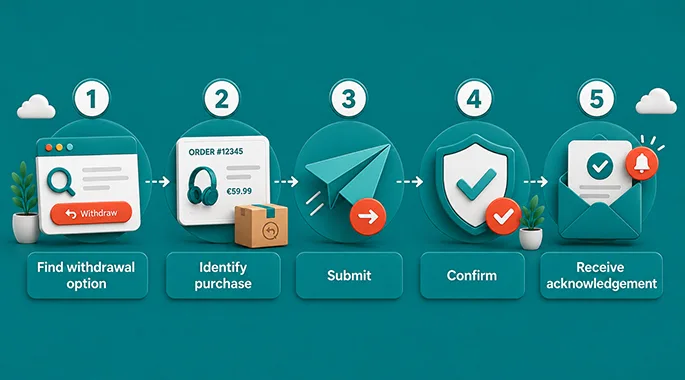
For eligible online purchases, the new function needs to be clearly visible, easy to access and continuously available throughout the relevant withdrawal period.
It must allow the customer to provide or confirm information identifying themselves and the purchase they want to withdraw from.
The customer then gets a clear confirmation step, and after submission the seller must provide an acknowledgement of the withdrawal without unnecessary delay.
In simple terms:
Find withdrawal option → identify purchase → submit → confirm → receive acknowledgement
That is why simply putting an email address or Contact Us page somewhere on the website is not the same thing.
“But What If…?” — Common Questions
Do all products I sell online have a 14-day withdrawal period?
No.
The 14-day right is the general rule for eligible online consumer purchases, but the law contains specific exceptions. Personalised goods, rapidly perishable products and certain sealed hygiene goods are examples.
The important thing is to consider each type of product, rather than assuming your entire shop is covered or exempt. Section 27 contains the statutory exceptions.
Some of my products are exempt. Does my whole website still need this?
Potentially, yes.
If your shop sells both exempt and non-exempt products, the eligible purchases still need to be handled correctly.
An exception for one product is not an exemption for the entire website.
Who pays the return shipping?
For an ordinary change-of-mind withdrawal, the customer can normally be made responsible for the direct return cost provided you informed them before they purchased.
If you did not tell them beforehand, the seller becomes responsible for that return cost.
Do I need to update my Terms & Conditions?
They should at least be reviewed.
If your Terms, Returns Policy or checkout information does not correctly explain the withdrawal right, relevant exceptions, return costs or the new online withdrawal process, changes may be required.
The website’s legal information and the process the customer actually uses should tell the same story.
Customers can already email me. Isn't that enough?
They can continue to email you.
But the new law specifically introduces an online withdrawal function for affected online purchases. An email address does not remove that requirement.
Why should I make it easier for customers to cancel?
Because the legal withdrawal right already existed.
The new EU rule does not suddenly invent the customer’s right to change their mind. It changes how easily they must be able to exercise that existing right online.
A structured process can actually help the seller too, because there is a clearer record of what the customer requested and when.
Nobody has ever complained. Should I just ignore it?
No. A complaint is not what makes the law apply.
If your business falls within the requirement, the obligation exists whether you have received 500 complaints or none.
One informed customer, one dispute or one compliance check can suddenly make the issue very relevant.
Waiting for somebody to complain before addressing a legal requirement is a little like waiting for somebody to fall before fixing the loose tile.
The Cyprus Consumer Protection Service has specifically called on affected businesses to study the new provisions and ensure compliance.
What Happens If You Ignore It?
This is a legal compliance requirement, not simply a recommended website improvement.
Under Cyprus consumer law, enforcement powers can include administrative fines of up to 5% of the business’s turnover in the previous year, depending on the circumstances of the infringement.
Where the relevant turnover information is unavailable, the law provides for a maximum fine of up to €3 million. Continuing infringements can also lead to additional penalties.
That does not mean that forgetting one website feature automatically results in a 5% fine.
The circumstances matter.
But it certainly puts this in the:
“deal with it”
category rather than the:
“maybe later”
category.
So, What Actually Needs to Change on Your Website?
This is the practical part.
The solution is not simply:
“Put a Cancel button somewhere in the footer and call it a day.”
An affected e-commerce website should be reviewed as a complete customer journey.
Depending on what you sell, this may include:
- reviewing which products are subject to the normal withdrawal right;
- identifying genuine exceptions that need different handling;
- clearly explaining withdrawal rights and exceptions before purchase;
- clearly stating who pays the cost of returning goods;
- reviewing your Terms & Conditions and Returns/Refund information;
- adding the required online withdrawal function in an easy-to-find location;
- allowing customers to identify the relevant purchase;
- providing the required confirmation step;
- recording the withdrawal request;
- sending the required acknowledgement to the customer; and
- testing the complete process from the customer’s point of view.
In other words:
The information customers see before they purchase, the withdrawal process itself and your website policies all need to work together.
If This Sounds Complicated, I Can Help
If your reaction after reading all of this is:
“I sell products online. I am not an expert in EU consumer law.”
Fair enough.
You are not expected to spend your evenings reading legislation for fun.
I can review your e-commerce website, explain in plain language what needs to change and implement the technical side of the withdrawal process for you.
This can include reviewing the current customer journey, implementing the required withdrawal functionality, making sure the relevant information appears where it needs to, setting up the necessary confirmations and testing the complete process from the customer’s point of view.
Where the legal status of a particular product requires specialist interpretation, this can be confirmed with your legal adviser and then reflected correctly on the website.
You do not need to understand every paragraph of the law. You do need to make sure your online shop deals with it properly.
If you are unsure whether your website is affected or what needs to change, use the contact form below and I can help you review your current setup and work out the next steps.
Need Help? Contact us 😊
References
- Cyprus Consumer Protection Service — Strengthening Consumer Protection in Distance Contracts
- Cyprus Consumer Protection Law — Full Consolidated Law
- Cyprus Consumer Protection Law — Section 22A: Online Withdrawal Function
- Cyprus Consumer Protection Law — Section 27: Exceptions from the Right of Withdrawal
- Cyprus Consumer Protection Law — Section 57: Enforcement Powers and Administrative Fines
- EUR-Lex — Directive (EU) 2023/2673
- Your Europe — B2C E-commerce, Distance and Off-Premises Selling
- Your Europe — Returns and the 14-Day Right of Withdrawal
- Your Europe — Returns and Withdrawal FAQs
- Your Europe — Legal Guarantees for Goods
This article provides general information about e-commerce implementation and consumer-law requirements. It is not legal advice. Where legal interpretation is required for a particular product, service or business situation, advice should be obtained from a qualified legal professional.


